|
|||||||||||||||
 |
The Martian Chronicles Radio drama, Colonial Radio Theatre, June 2011. |
|||||||||||||||||||||||
|
The Martian Chronicles
Bradbury has written a stage production, published by Dramatic Publishing in 1986.
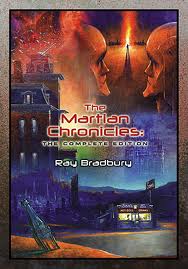
Bradbury has written a number of different screen adaptations of the complete Chronicles, but none of them has been filmed. The recent small-press edition of The Martian Chronicles: the Complete Edition contains two of Bradbury's complete screenplays.
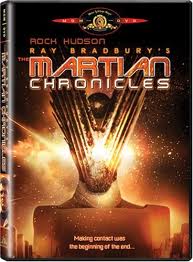
The only previous media production of the Chronicles to attempt an adaptation of the whole book was the 1979 TV miniseries, scripted by Richard Matheson and directed by Michael Anderson.
|
Dramatised by Jerry
Robbins, from the novel by Ray Bradbury Cast: Shana Dirik, Jerry Robbins, Jeffrey Gage, Kerry Donovan, Gunnar Lekborg, Diane Capen, Marcia Friedman, James Tallach, Mark Thurner, Jeremy Benson, Deniz Cordell, Tom Berry, B.J.Chamberlain, J.T.Turner, Patrick Clark, Rik Pierce, Andrew Marchev, Joseph Zamparelli, Rob Mattson, Justin O'Brien, Duncan O' Brien, Lucien E.G. Spelman, Tim Vincent, Robert Antonelli, M Sierio Garcia, Todd Radford, Hugh Metzler, Sam Donato, Dan Powell, Benjamin Hull, Brandon Moore, Caitlyn Hubbard, Shonna McEachern, Leigh Berry, Lincoln Clark, Amy Sheridan, Joe Caliendo Jr, Katie Desisto, Barbara Dempsey West, Isaac Bean, April Sadowski, David Ault, Jordan Rich, Ken Carberry, M.J.Cogburn, Seth Adam Sher, Jim Hamilton, Jon Specht, Judson Pierce, Cynthia Pape, Elie Hirschman, Mason Cogburn, Michael Cogburn, Jack Lebresco, Kerry Anne Kilkelly, Anastas Varinos.
Successive attempts to land on Mars are thwarted by Martians, until disease carried by Earthmen inadvertently wipes out the native population. Mars becomes the new frontier for Earth people, and successive waves of colonisation take place. Meanwhile, unrest on Earth threatens to bring about a final World War. The few remaining colonists on Mars finally realise that, with the natives gone and with no Earth to return to, they are the Martians now.
This is Colonial's fourth outing with Ray Bradbury material, following on from their award-winning productions of Dandelion Wine, Something Wicked This Way Comes and The Halloween Tree. Spanning six CDs, with a running time of five-and-a-half hours and a cast of fifty-five, the production is a full dramatisation of the whole of Bradbury's book It draws from the 1997 version of The Martian Chronicles, which means the revised timeline - Bradbury pushed all the stories further into the future, since the real calendar was catching up with his fiction. It also means that all of the Chronicles stories are included with the exception of "Way in the Middle of the Air", which Bradbury dropped because it had become outdated. So this dramatisation includes "The Fire Balloons", "Usher II" and "The Wilderness", three stories which have been in and out of the Chronicles several times in the book's sixty-year history. Writer-director Jerry Robbins modestly claims that all he has done here is a matter of formatting: "All I did was to dramatise what he had written, and that's how we recorded it - so I take absolutely no credit here. Every word in the script is from Ray. All I did was re-format the book into a script." It's not true, of course. There is some inventive interpretation going on in this production, of which more later. But even if it were true, it would be quite an achievement. Until now, the only media adaptations of the entire Chronicles have been a ridiculously condensed thirty minute version for radio's Dimension X, and the "boring" 1979 TV mini-series starring Rock Hudson. "Boring", by the way, being Ray Bradbury's own description for that production. What Colonial have done is to treat the book with some respect, and have decided that it is a story worth telling, in full. And although they call themselves a radio company, they are actually able to benefit from the fact that this isn't really for broadcast: instead of being stuck with a rigid timeslot - thirty-minute episodes, or one-hour episodes for example - they have allowed themselves to be flexible. Just as Bradbury's Chronicles chapters vary in length from half a page to twenty pages, so Colonial's Chronicles has stories ranging from a few seconds to forty minutes. (Jerry Robbins tells me that there will be broadcasts of The Martian Chronicles, with some minor adjustments to fit the broadcast slot. It will be interesting to see how they divide it up.) Apart from this flexibility in timing, what else is new in this production? What struck me first was the music. As with previous Colonial productions, Jeffrey Gage has concocted an original score which makes for a decidely filmic experience. And then there are the narrators. Plural. In place of the third-person narration of Bradbury's text, Robbins has opted to use multiple voices to narrate, especially during the short bridging passages between the main stories. This tactic is shown straight away, in "Rocket Summer", and prepares us for a Chronicles that, by its very nature, will be fragmentary. Some of the narrators remain third-person, but because they are recognisable voices, we can in some cases clearly identify them with characters in the drama. Others become first-person, and this works well. "The Green Morning", the story of the man who Johhny Appleseeds his way across Mars, is my favourite of these. Many stories from The Martian Chronicles have had a life of their own in adaptation. There have been countless adaptations of "And The Moon Be Still As Bright" and "The Third Expedition" (also known as "Mars is Heaven!"). This makes it exceptionally hard for Colonial, especially since their aim is to dramatise rather than to alter the text, but they have done strong work with these familiar chapters, particularly with the voice casting and the use of atmospheric sound and music. The ending of "The Third Expedition" is supposed to be a surprise, and they have made it so. The charm of this production, though, lies in the chapters which have been adapted less often. That's why "The Green Morning" is so fresh, and the same is true of "The Wilderness" and "Night Meeting". It is in some of these - and in some of the bridging passages, which also seldom get adapted - that we are reminded of some of the strong themes of The Martian Chronicles. One of the key themes is loneliness; some of the characters go there to escape it, others go there and find it. This comes across in "The Wilderness" with its dramatisation of the time-delay in the phone call to Mars. Another theme is the near impossibility of one species comprehending another, which is effectively demonstrated in "Night Meeting". The only episode I have a problem with is "Usher II", but not because of anything Colonial have done with it. It's a splendid dramatisation, with J.T.Turner putting in an energetic turn as Stendahl, the man who constructs his own House of Usher on Mars. No, the fault lies with Bradbury: the tone of "Usher II" is totally at odds with the tone(s) of the rest of the book. No wonder he has, in the past, had second thoughts about including it in the book. So how does this compare with Colonial's other productions of Bradbury? Very well, I think. Like The Halloween Tree it is an attempt to work directly from the book (whereas Dandelion Wine and Something Wicked This Way Comes were both performances of Bradbury's own stage plays). Unlike The Halloween Tree it is potentially hamstrung by the lack of a central plot or protagonist to drive it forward. But the key creative decisions represented here - letting each story take its own sweet time; bringing the bridge passages to life as well as the main stories; and using mixed and multiple narrators - make this inventive production a classic Bradbury production. Like Bradbury's book, which can't really decide whether it's a novel or a short-story collection, this dramatisation lends itself both to serial listening and dipping in and out, revisiting favourite chapters. Don't expect TV or film to ever give you The Martian Chronicles like this. This is the medium Bradbury was made for! |
|
||||||||||||||||||||||
|
Ordering and other information can be found at Colonial Radio Theatre's website. |
||||||||||||||||||||||||
 |
|
|
|
|
|
|
|
|
|
|
|
|
|
|
|
|
|
|||||||

.jpg)